
Implementation research: including breast examinations in a cervical cancer screening programme, Rwanda
Bulletin of the World Health Organization
15 Oct 2024
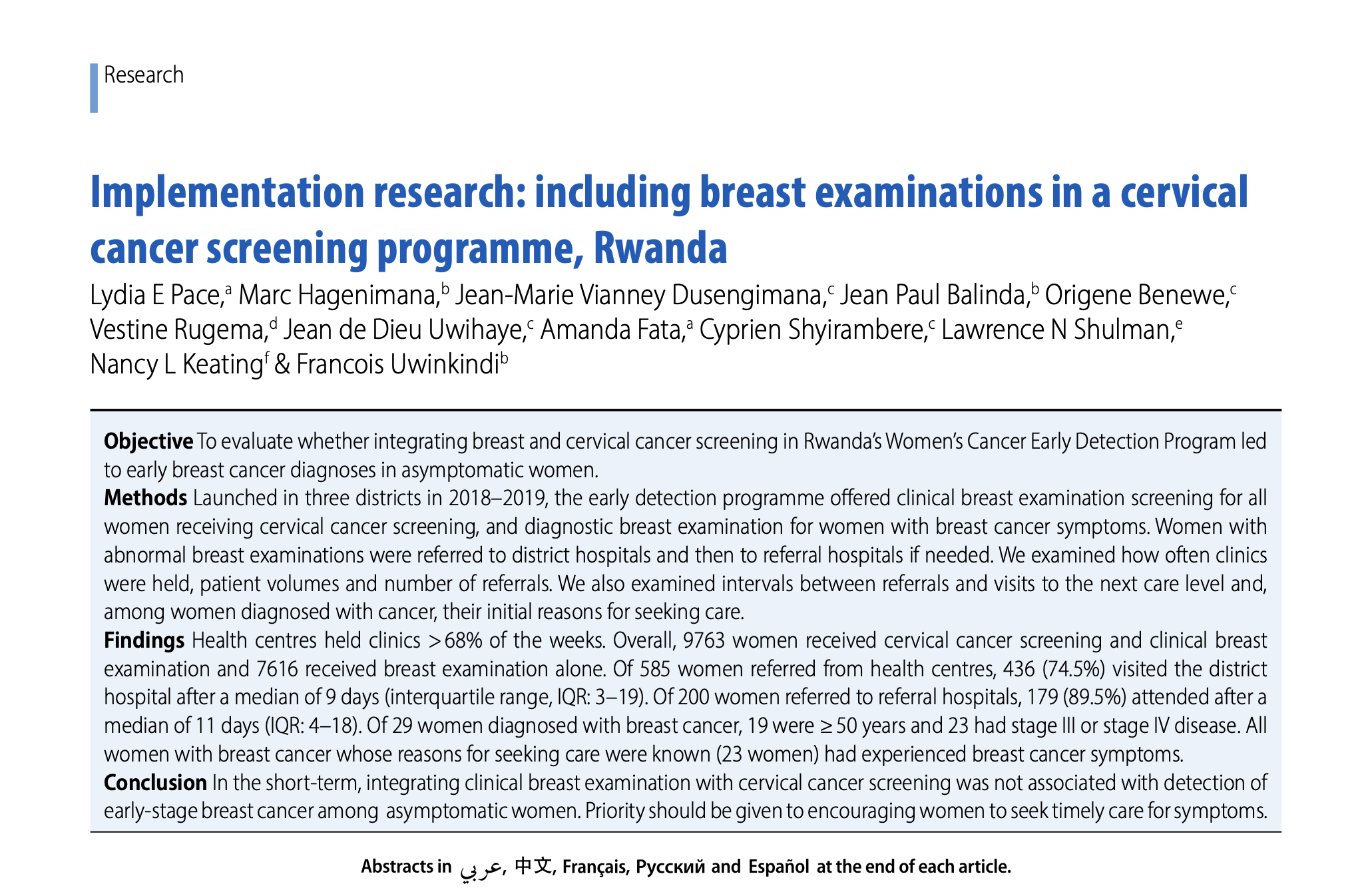
Abstract:
Objective To evaluate whether integrating breast and cervical cancer screening in Rwanda’s Women’s Cancer Early Detection Program led
to early breast cancer diagnoses in asymptomatic women.
Methods Launched in three districts in 2018–2019, the early detection programme offered clinical breast examination screening for all
women receiving cervical cancer screening, and diagnostic breast examination for women with breast cancer symptoms. Women with
abnormal breast examinations were referred to district hospitals and then to referral hospitals if needed. We examined how often clinics
were held, patient volumes and number of referrals. We also examined intervals between referrals and visits to the next care level and,
among women diagnosed with cancer, their initial reasons for seeking care.
Findings Health centres held clinics > 68% of the weeks. Overall, 9763 women received cervical cancer screening and clinical breast
examination and 7616 received breast examination alone. Of 585 women referred from health centres, 436 (74.5%) visited the district
hospital after a median of 9 days (interquartile range, IQR: 3–19). Of 200 women referred to referral hospitals, 179 (89.5%) attended after a
median of 11 days (IQR: 4–18). Of 29 women diagnosed with breast cancer, 19 were ≥ 50 years and 23 had stage III or stage IV disease. All
women with breast cancer whose reasons for seeking care were known (23 women) had experienced breast cancer symptoms.
Conclusion In the short-term, integrating clinical breast examination with cervical cancer screening was not associated with detection of
early-stage breast cancer among asymptomatic women. Priority should be given to encouraging women to seek timely care for symptoms.