
National Cancer Control Planning for Programme Managers
WHO
09 Feb 2026
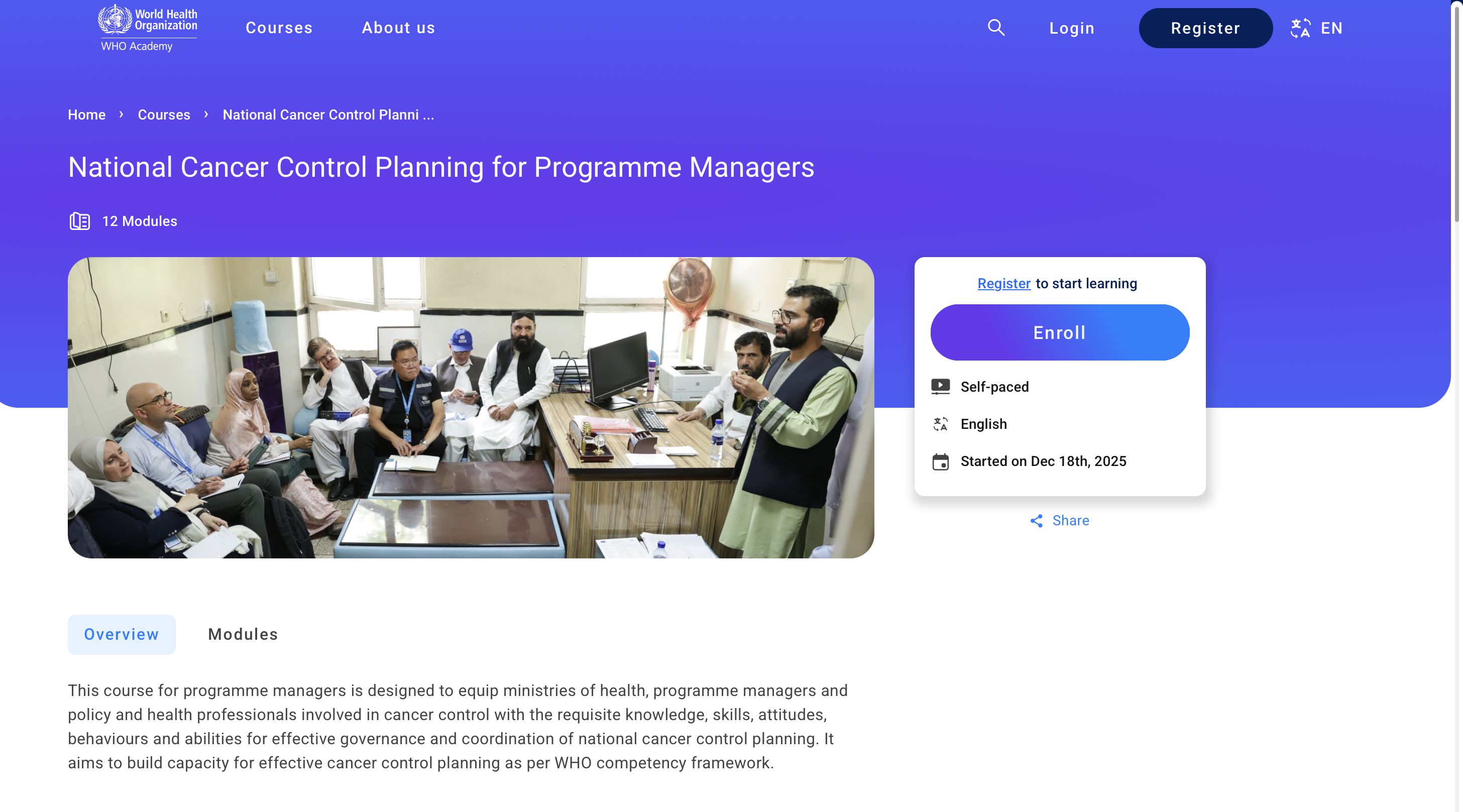
This course for programme managers is designed to equip ministries of health, programme managers and policy and health professionals involved in cancer control with the requisite knowledge, skills, attitudes, behaviours and abilities for effective governance and coordination of national cancer control planning. It aims to build capacity for effective cancer control planning as per WHO competency framework.

Explore the basics of cancer prevention, control and management;

Construct an understanding of the global initiatives;

Identify how to pre-plan and prioritize as well as draft, cost, budget and resource and NCCP;

Comprehend implementing, monitoring and evaluating an NCCP; and

Illustrate how to advocate, communicate and create strategic partnerships.
Programme managers, policy and health professionals in managerial positions involved in processes related to the formulation and implementation of cancer control programmes.
- Number of modules: 9
- Approximate course duration: 10 hours
- Learning modality: Online self-paced
- Early-release course: You are enrolling in an early-release version of this course. We encourage you to provide feedback on your learning experience. We will use your feedback to adapt and improve the course and the WHO Academy online learning platform.
You will receive a WHO Academy Award of Completion upon completing all learning. The award will be saved in your ‘My Learning / Achievements’ space and can be downloaded and shared.
Produced by: Content of this course was developed & validated by the WHO HQ Cancer Initiatives, WHO regional offices of EMRO, PAHO and WIPRO, WHO Country offices of Ghana and Morocco and several other partners through the expert advisory group, The MOHs of Peru, Malaysia, Cote d’Ivoire, the Kyrgyz Republic, and the National Cancer Institute of Thailand provided case studies. IARC and IAEA reviewed the content and external validation was provided by National Cancer Center Korea.
Supported by: Financial support to produce this course was provided by the Republic of Korea, the National Cancer Institute USA (NCI-US) and St Jude Children’s Research Hospital.
Conflict of interest: All experts declared no conflicts of interest. WHO found no actual or perceived conflicts related to this course.